
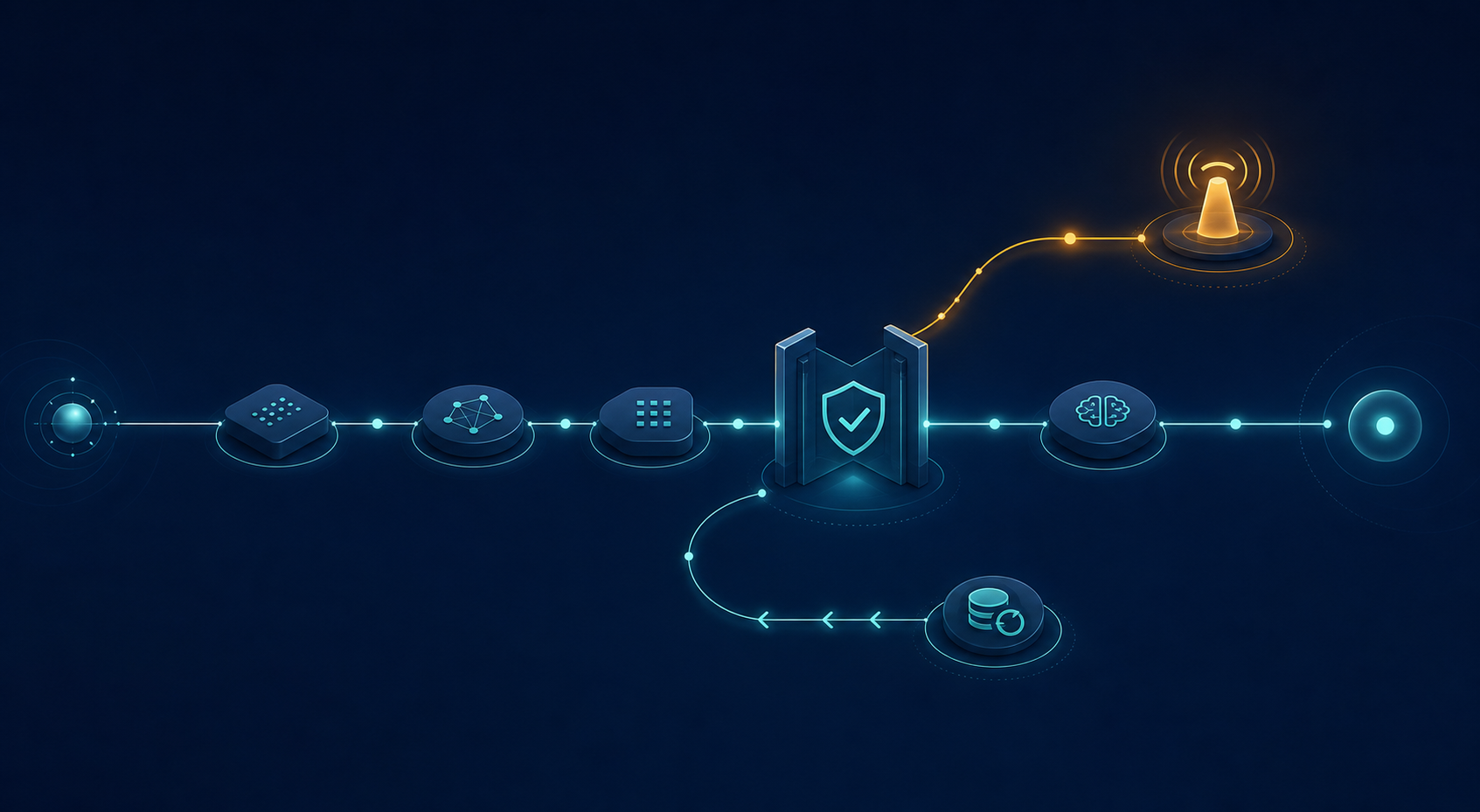
AI agent observability is often reduced to a trace viewer. Traces matter, but a production team needs more than a record of model and tool calls. It needs a way to detect business-impacting failures, contain them, assign an owner, and decide whether to retry, degrade, or roll back.
That operating layer becomes essential after the demo. An agent can return a fluent answer while using stale knowledge, call the correct tool with the wrong scope, or complete a workflow that violates a business rule. Conventional uptime alone will not reveal those failures.
This runbook connects agent traces to service-level objectives (SLOs), alerts, incident response, governance, and release controls. It is designed for operations and engineering leaders who need to keep an agent-backed workflow dependable without pretending that every failure can be predicted in advance.
Observability starts with the business outcome
Begin with the workflow the agent is meant to complete, not with the model dashboard. A customer-service agent may need to identify an account, retrieve the relevant policy, propose a resolution, and update a case. An internal knowledge agent may need to find an approved source, answer with evidence, and abstain when the evidence is insufficient.
For each workflow, define the acceptable outcome, the unacceptable outcome, and the recovery path. Then connect those definitions to telemetry. This prevents a common mistake: collecting thousands of spans while remaining unable to answer whether customers received correct, authorised, and timely service.
A useful observability model has three linked levels:
- Business outcome: Was the case resolved, request completed, or employee question answered appropriately?
- Control outcome: Were required approvals, permissions, citations, and policy checks applied?
- Technical execution: Which model, retrieval step, tool, handoff, or dependency caused the result?
OpenTelemetry's overview of AI agent observability and evolving standards explains why telemetry must represent interactions among models, tools, memory, and other agents. The practical implication is that one model-call log is not enough. The team needs a connected record of the whole workflow.
If the agent can take consequential action, observability should also connect to the controls described in a production AI agent approval workflow. A trace should show why a gate fired, what the reviewer saw, who decided, and whether the executed action still matched the approved payload.
Define a minimum trace contract
A trace contract is the smallest set of fields every production run must emit. Standardising it early makes incidents easier to compare across models, frameworks, and teams. It also reduces dependency on one vendor's proprietary view.
At minimum, capture a workflow or conversation ID, trace and span IDs, agent and policy versions, model identifier, tool name, retrieval source references, timestamps, latency, token or usage data when available, decision outcome, and a structured error category. Record the acting user or service identity in a privacy-preserving form and include the deployment environment and release version.
Represent each meaningful step as a span: orchestration, model call, retrieval, tool invocation, approval, handoff, and final outcome. Parent-child relationships should reconstruct the sequence without relying on a free-form transcript. For long-running work, use a stable workflow ID so a resumed job remains connected to its earlier steps.
Do not log every input blindly. Prompts, retrieved documents, tool arguments, and outputs may contain personal data, credentials, customer records, or confidential policy. Decide which fields are stored in full, redacted, hashed, sampled, or excluded. Apply access controls and retention rules to traces as deliberately as you would to the business systems they describe.
Microsoft's guidance on observability for generative and agentic AI systems places telemetry inside a wider security model. That is the right framing: trace access, integrity, retention, and auditability are part of the control surface, not housekeeping tasks to add later.
Map failure layers to signals and action
Agent incidents rarely fit one generic “LLM error” label. Classify failures by layer so the alert reaches someone who can act. The following operating map is a starting point, not a universal standard.
| Failure layer | Signal to observe | Typical operational response |
|---|---|---|
| Model | refusal, malformed output, unexpected language, latency, rate limit | retry within policy, switch an approved fallback, or degrade to a bounded workflow |
| Retrieval | no authoritative source, stale index, weak evidence, conflicting documents | abstain, refresh the index, route to a content owner, or use a verified source path |
| Tool | timeout, permission denial, invalid arguments, partial write | stop retries when unsafe, reconcile side effects, and engage the system owner |
| Orchestration | repeated loop, lost state, failed handoff, exceeded step limit | halt, restore from a checkpoint, or move the task to a manual queue |
| Policy and approval | missing gate, expired decision, authority mismatch, payload changed | fail closed, invalidate the request, and investigate a control breach |
| Business outcome | wrong resolution, duplicate action, unresolved case, policy exception | contain customer impact, correct the record, and feed the event into evaluation |
This separation helps teams avoid noisy alerts. A transient model timeout with a successful retry is different from a duplicate refund or an answer grounded in an obsolete policy. Both belong in the trace, but only one may require immediate incident handling.
It also exposes ownership gaps. Engineering may own orchestration and deployment, while operations owns business exceptions, a knowledge owner handles source quality, security owns access breaches, and product decides acceptable degradation. Record those assignments before the first incident rather than improvising during one.
Teams building internal knowledge AI with cited answers should pay particular attention to retrieval freshness, source authority, abstention, and citation validity. Customer-facing automation needs a different emphasis: identity, policy compliance, handoff quality, external actions, and recovery when an answer or action is wrong.
Build SLOs around reliability and risk
An SLO turns “the agent should work” into an explicit service expectation. Do not begin with an arbitrary target copied from another company. Establish a measured baseline, classify workflows by consequence, and set objectives that reflect customer commitments and recovery capacity.
A production agent may need several service-level indicators (SLIs): successful workflow completion, correct policy application, grounded-answer rate under a defined evaluation method, tool success, approval latency, handoff completion, duplicate-action prevention, and cost per completed workflow. Each indicator needs a precise numerator, denominator, data source, owner, and exclusion policy.
Separate hard operational signals from evaluation signals. Tool errors and queue latency can often be measured directly. Answer correctness or policy compliance may require labelled samples, deterministic checks, or model-assisted evaluation with periodic human calibration. NIST's Generative AI Profile recommends ongoing monitoring and defined human-oversight responsibilities; it does not provide a universal target for your workflow.
Use risk tiers to decide what pages an on-call team. A failed low-risk draft might enter a review queue. An agent sending an unauthorised external message, exposing restricted data, or repeating a financial action may require immediate containment. Error budgets can guide release velocity, but they must not legalise prohibited outcomes. Some controls are boundaries, not averages.
A useful SLO review asks three questions:
1. Are users receiving the intended outcome within an acceptable time?
2. Are the policy, permission, and evidence controls working?
3. Can the team detect and recover from failure before impact grows?
Route alerts to decisions, not dashboards
An alert is useful only when it implies a decision. Every page should identify the affected workflow, risk tier, release version, likely failure layer, current blast radius, and immediate safe action. Link directly to a filtered trace and the relevant runbook rather than asking responders to search several systems.
Create distinct alert paths for availability, quality, security, cost, and control failures. A sudden increase in tool timeouts may go to engineering. A spike in unsupported answers may go to the knowledge owner and product team. A gate bypass or unexpected privileged action should reach security and the business system owner. Cost anomalies need enough context to distinguish legitimate demand from loops, prompt growth, or retry storms.
Use aggregation and windows to avoid paging on every non-deterministic variation. Page for sustained or high-consequence conditions; create tickets for slower trends; sample cases for quality review. Alerts should include a stop condition so responders know when the incident is contained.
The runbook for each alert should specify:
- who is incident commander and who owns the business decision;
- which automated actions may continue;
- how to disable a tool, workflow, tenant, or release;
- the approved degraded mode or manual fallback;
- how to identify potentially affected records or customers;
- how to reconcile partial or duplicate side effects;
- and what evidence must be preserved for review.
This is where an enterprise AI pilot-to-production roadmap becomes operational. Ownership, rollback, evaluation, and change control must exist before autonomy expands.
Contain, degrade, and roll back safely
When an incident starts, first protect the business boundary. Pause the risky action, revoke or narrow the relevant permission, disable the affected tool, or route new work to a manual queue. Do not keep retrying a side effect simply because the model call is retriable.
Next, determine the smallest safe containment scope. It may be one tenant, one workflow, one tool, one model release, or one policy version. Broad shutdowns can create their own operational harm, while narrow controls reduce impact and preserve service elsewhere.
A rollback plan must cover more than model selection. Prompts, tools, retrieval indexes, policies, memory schemas, orchestration code, and external APIs can all change behaviour. Version these components and record their combination in every trace. If the previous release depends on an older index or tool contract, a partial rollback may be unsafe.
Prefer a known degraded mode over an improvised one: provide retrieval-only answers with citations, create drafts without sending them, disable write tools, require approval for every consequential action, or transfer the case with a structured summary. OWASP's guidance on excessive agency reinforces that human approval is only one layer; narrow functionality, least privilege, user-context authorisation, and downstream policy enforcement remain necessary.
After containment, reconcile side effects before replaying work. Confirm whether messages were sent, records changed, or payments initiated even if the agent did not receive a success response. Idempotency keys and external transaction IDs are essential evidence. Only resume when the team can distinguish safe retries from duplicate actions.
Turn incidents into safer releases
A post-incident review should connect the customer or business impact to the exact trace, control gap, and release decision. Avoid ending with “the model hallucinated.” Ask why the system accepted the output, why a tool had that scope, why evaluation missed the pattern, why the alert arrived late, or why the fallback failed.
Convert representative incidents into regression tests and evaluation cases. Include the original evidence state, expected decision, prohibited action, and acceptable fallback. Run that set before changing models, prompts, retrieval, tools, or policies. Canary releases should compare both technical health and business-control outcomes before wider rollout.
Review telemetry itself. Missing spans, inconsistent IDs, unredacted fields, and traces that cannot be joined to business outcomes are production defects. Observability coverage should be a release gate for high-consequence workflows, just like authorisation and rollback readiness.
If your team can see agent traces but cannot turn them into ownership, SLOs, alerts, and safe recovery, a workflow audit can identify the missing operating controls. OpenCraft maps the current process, systems, decision rights, failure paths, and measurable handoffs before implementation. Discuss a Workflow Audit with OpenCraft.
Sources and further reading
Adapted from the original source (OpenCraft).
Read the original article